Recycling and Sustainability at Hoxton Skip Hire
At Hoxton Skip Hire we are committed to delivering an eco-friendly waste disposal area and a truly sustainable rubbish area for homes, small businesses and construction projects across Hoxton and the wider Hackney borough. Our approach blends local knowledge, practical reuse partnerships and measurable targets so every skip we manage contributes to a circular, low-carbon local economy.We work with a network of local recycling yards and transfer facilities to ensure waste is sorted and processed responsibly. Our team sorts loads at source and directs materials to the best local transfer stations and materials recovery facilities (MRFs) serving Hackney, Tower Hamlets and neighbouring boroughs.
Our Recycling Percentage Target
We have set an ambitious recycling percentage target to drive continuous improvement: a minimum of 70% of all collected waste diverted from landfill by 2028. This target applies to all our skip services — from household clear-outs to site-wide construction collections — and is measured by weight and material type so we track progress by tonnes diverted and by percentage.How we achieve high diversion rates
We combine practical on-site separation with downstream processing: mixed recycling goes to local MRFs, timber and inert materials to specialist processors, and hazardous or electronic waste to licensed handlers. Our operations reflect the boroughs' approach to waste separation—Hackney encourages separate food waste and mixed recycling streams—and we align our collection methods so residents and contractors get consistent, compliant service.Key actions that support the recycling goal include:
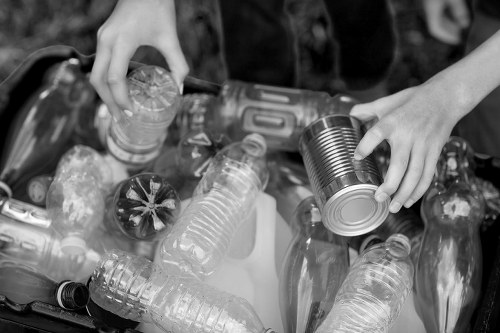
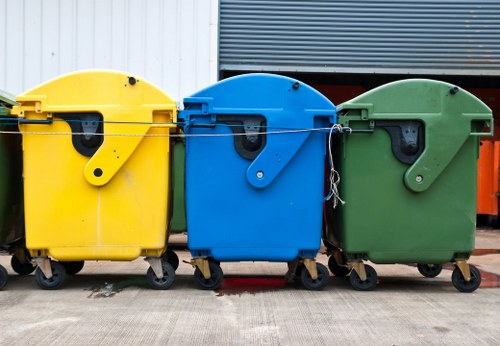
- Source segregation: Clear labelling on skips and simple guidance so customers separate recyclables (paper, card, metal, plastic, glass).
- Reuse-first routing: Items fit for reuse are diverted to refurbishment partners and charities.
- Accurate reporting: Regular weight-based reports to clients showing material breakdown and percentage diversion.
Local Transfer Stations and Facilities
We prioritise transfer stations and facilities within Greater London to reduce haulage distance, time and carbon. Typical destinations include local MRFs and licensed transfer stations serving Hackney and neighbouring boroughs; we work with operators who handle segregated streams efficiently so less material is processed twice. Using nearby facilities helps deliver a lower-carbon skip hire service and faster turnaround for customers.Partnerships with Charities and Social Enterprises
Hoxton skip services place strong emphasis on reuse. We partner with local charities and social enterprises to give furniture, textiles and usable fixtures a second life. Partners include donation networks, community reuse centres and food redistribution organisations focused on London neighbourhoods. Through these collaborations we reduce waste, support vulnerable communities and extend the lifecycle of items that would otherwise be lost to disposal.Examples of charity-focused streams we run:
- Furniture and soft furnishings — donated to local reuse charities when safe and serviceable.
- Building materials — offcuts and salvageable fixtures sent to social enterprises for resale or community refurb projects.
- Food waste and surplus food — where applicable, surplus, unopened items are supplied to food redistribution charities.
Low-Carbon Vans and Greener Logistics
Our fleet is transitioning to low-carbon vans to minimise emissions across the service lifecycle. We already operate a mix of electric vans, plug-in hybrids and Euro-6 vehicles with plans to increase electric vehicle (EV) usage for local collections. Combined with route optimisation software and consolidated drop-offs to local transfer stations, these measures reduce fuel consumption and emissions per tonne collected.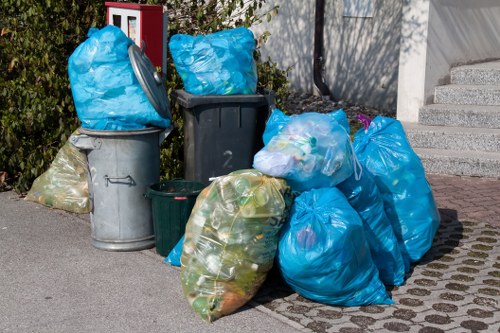
Waste Types and Borough Recycling Practices
The Hoxton area follows borough-level guidance that emphasises separation of food waste, recyclables and residual waste. We support those systems by offering skips clearly labelled for mixed recyclable materials, wood and plasterboard, and general residual loads, which mirrors many borough collection strategies and simplifies onward processing.We also encourage clients to separate lighter recyclable fractions (paper, card, plastic) at site to prevent contamination and increase recovery rates. Where local schemes collect separate glass or organics, we coordinate our collections to complement those municipal services rather than duplicate them.